War is often perceived and confined to geopolitical conflicts; however, this is far from the truth. America wages war on its own people, and it manifests in the form of social injustices, systemic and institutionalized oppression. To understand how this war is lived, interpreted, and defined in America, I attended a cultural event titled ‘Building Freedom on the Road to Abolition.’ Here, I had the opportunity to hear community organizers discuss the pervasive issue of mass incarceration and state-sanctioned violence, with a specific focus on Ohio. What unfolded was a profound exploration of the war being waged against marginalized communities within the confines of my own neighborhood.
The very essence of mass incarceration exposes a system that prioritizes punitive measures and is not concerned with ensuring safety, but rather with controlling the dispossessed.
The legal system is typically seen as one that upholds justice and fairly responds to crime. Mass incarceration refers not only to the criminal legal system but extends to laws, rules, and policies that control those deemed criminals inside and outside of prison. It is not merely a result of individual criminal behavior but is deeply rooted in structural inequalities.
For example, the war on drugs has disproportionately targeted communities of color, particularly Black and Latinx individuals, despite similar rates of drug use across racial groups.
The United States incarcerates people at a higher percentage of its people than any democratic country on earth.
According to the Prison Policy Initiative, (2021), Ohio has an incarceration rate of 659 per 100,000 people (including prisons, jails, immigration detention, and juvenile justice facilities).
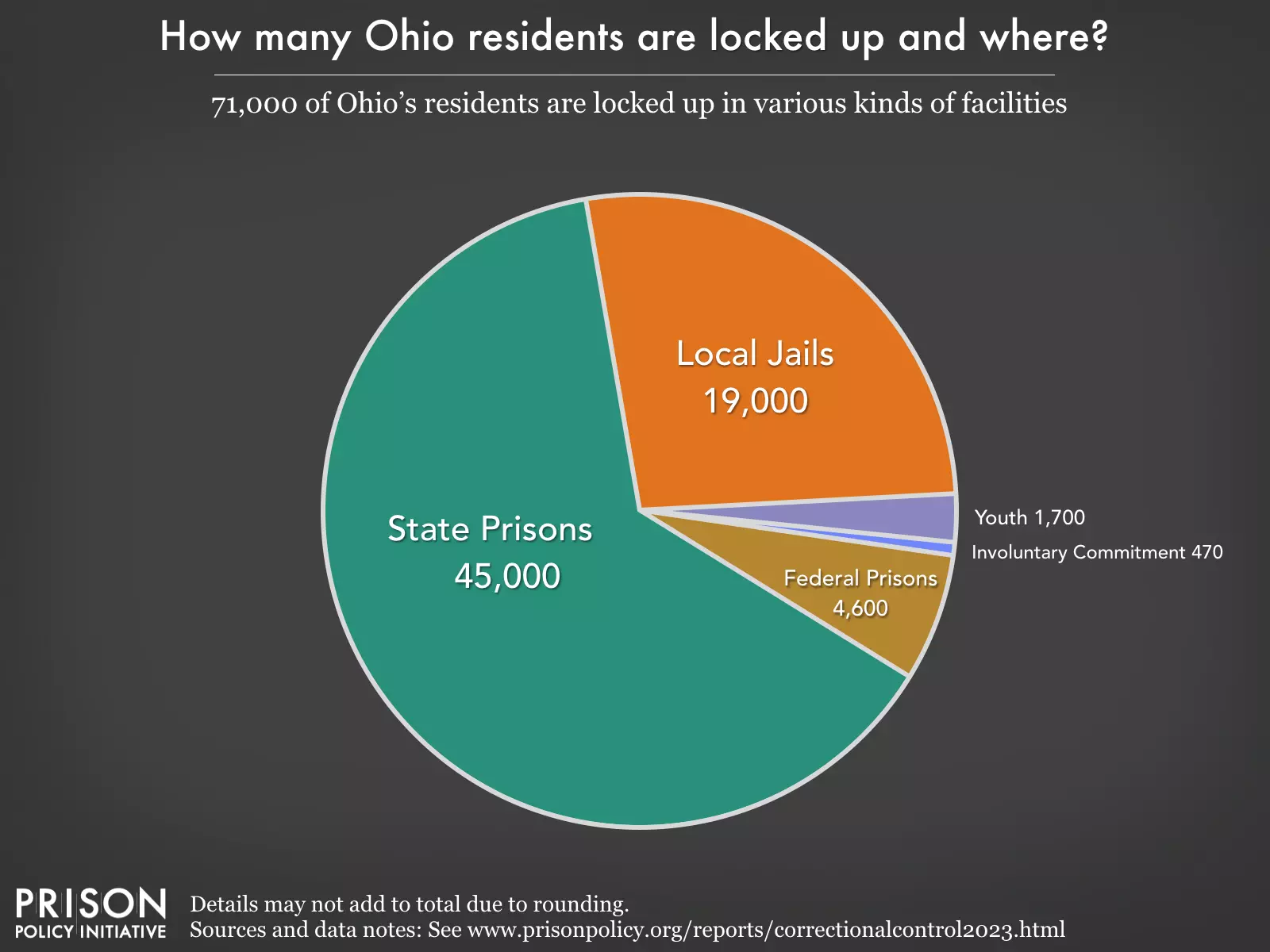
The Prison Policy Initiative states,
“the number of people impacted by county and city jails in Ohio is much larger than the graph above would suggest, because people cycle through local jails relatively quickly.”
At the ‘Building Freedom on the Road to Abolition’ event, they provided startling statistics. For example, last year in Ohio, nearly 43,000 people were incarcerated in state prisons, at a cost of $1.9 billion annually, or $99.96 per person per day. And, in Cuyahoga County, where on average 1,600 people are incarcerated daily in the county jail, that cost exceeds nearly $99.3 million annually, or $165 per person on any given day.
Collateral consequences, such as housing and employment barriers, exacerbate socioeconomic disparities and perpetuate cycles of poverty and crime. Upon release, having financial security is vital for formerly incarcerated people. However, it is challenging for formerly incarcerated people to escape the effects of a criminal record, especially when seeking employment. Despite looking for employment, formerly incarcerated people are almost five times more likely than the public to be unemployed, and if they find employment, they often receive an income that is below the poverty line.
The average wages lost by Ohioans who have served time for a felony amount to a staggering $36,479.
This financial burden perpetuates cycles of poverty, with many reentering the criminal legal system. It's a grim reality where one in four jobs remains out of reach for individuals with a conviction, effectively ostracizing them from entering the ‘real world’ and making it nearly impossible to access economic opportunities and social mobility. With no opportunities for reintegration upon being released, most will eventually return to prison and then be released again, creating a never-ending cycle of perpetual marginality.
Having community organizers discuss the issues facing our communities, and providing startling statistics, this event highlighted the harsh realities of mass incarceration. It framed war not simply as physical international conflict on distant battlefields, but also as a pervasive force that infiltrates our community and robs individuals of their freedom, autonomy, and humanity.
Attending this cultural event served as a reminder of the ongoing struggles faced by marginalized communities and the importance of collective concrete action in effecting meaningful change.
The event was rooted in abolition principles, challenging attendees to question the status quo and envision alternative approaches to justice; thus, it undoubtedly builds resistance against the culture of war and state-sanctioned violence perpetuated by mass incarceration. From having grassroots organizations, community members, and engaging in community-based initiatives, participants were introduced to concrete strategies for resistance. The emphasis on collective action and solidarity underscored the transformative potential of resistance against systems of oppression, state-sanctioned violence, and the status quo.
References:


No comments:
Post a Comment